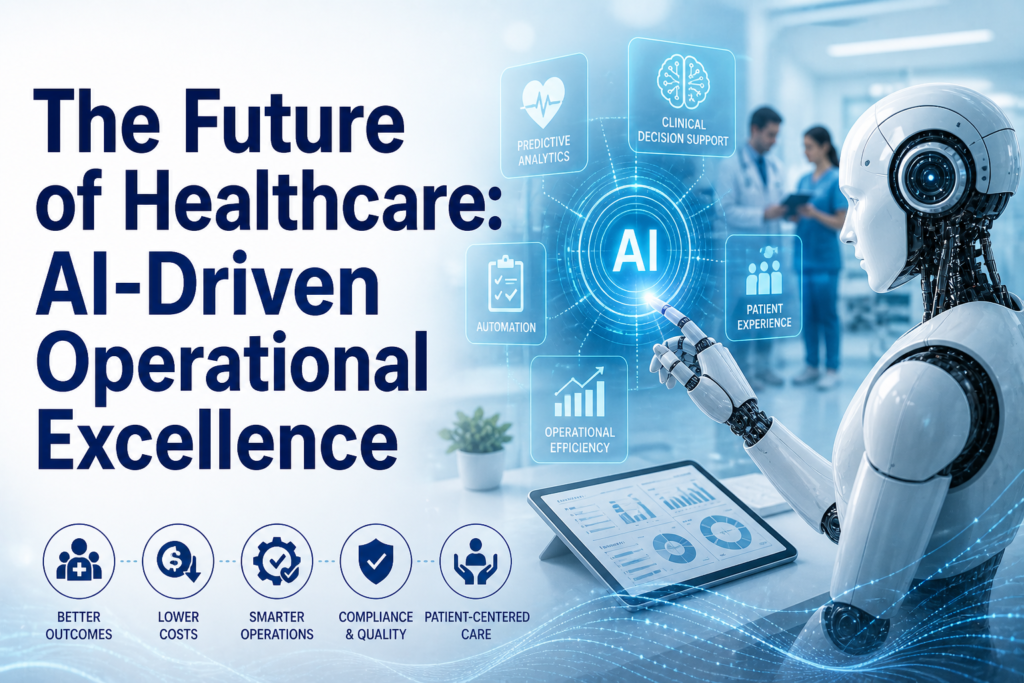
Healthcare is experiencing one of its biggest transformations yet. The escalating demands of patients, soaring costs of operations, complications in compliance, and increasing prevalence of chronic illnesses have driven the need for a swift evolution within healthcare sectors. The conventional methods, characterized by manual operations and inefficient systems, can hardly suffice the current needs.
Central to this transformation is the emergence of Artificial Intelligence (AI). From predictive analytics and diagnosis to automation and administration, AI is reshaping how healthcare organizations operate, especially when integrated with medical billing services to enhance overall operational performance and efficiency.
Operational excellence in healthcare entails providing quality patient care services without wasting unnecessary resources and making minimal errors. AI-based operational excellence takes this to an even higher level by employing intelligent systems to accomplish such objectives.
In conclusion, the role of artificial intelligence in delivering operational excellence cannot be ignored any longer.
What Is AI-Driven Operational Excellence in Healthcare?
Operational Excellence Using Artificial Intelligence in Healthcare is about embedding AI technologies within clinical and non-clinical operations in order to achieve maximum efficiency, accuracy, and effectiveness,especially when integrated with radiology billing services for handling complex and data-intensive healthcare workflows.
Concept and Definition
It includes the application of intelligent AI software such as machine learning, predictive analysis, and automation tools to optimize operations and minimize wastage. While traditional systems heavily depend on human action, AI-driven systems use intelligent software to analyze and derive insights from huge chunks of data.
Role of Artificial Intelligence in Boosting Healthcare Operations
The important roles played by AI in boosting healthcare operations include the following:
- Automating repetitive administrative processes
- Increasing accuracy of diagnoses
- Optimizing the utilization of resources
- Engaging patients effectively
- Helping clinicians make decisions
Traditional Vs AI-Driven Operations
Traditional systems are usually reactive, manual, and error-prone while the latter are proactive, data-driven, and continuously improving.
Why AI Is Transforming Healthcare Operations
Increasing Complexity in Healthcare Systems
Large amounts of data are produced by health care systems daily. The manual handling of data is inefficient and prone to errors.
AI makes possible the rapid processing of large amounts of data and helps to derive conclusions and gain insight into what is impossible without it.
Demand for Efficiency and Accuracy
Inaccuracy may cause fatal consequences in the health sector. Accuracy is important because health care organizations depend on it both financially and from the point of view of patients’ safety.
AI minimizes inaccuracies in data collection and analysis and increases the speed of decision-making.
Rising Patient Expectations
In today’s world, patients expect personalized, fast, and effective health services. Patients want to receive their diagnoses immediately, have no delays, and communicate effectively.
AI helps the health care system cope with patients’ requirements and provide personalized services.
Key Applications of AI in Healthcare Operations
1. Predictive Analytics for Patient Care
Predictive analytics makes use of past and current data to predict patients’ futures and detect any risks.
- Detection of diseases early
- Identifying patients at high risk
- Prevention of complications
Such an approach results in better patient outcomes and less expensive care.
2. AI in Clinical Decision Support
AI-based diagnosis helps doctors diagnose conditions and provide appropriate treatments.
- Data analysis from patients and images
- Evidence-supported medical advice
- Higher accuracy of diagnosis
These innovations increase clinical effectiveness and minimize risks.
3. Automated Administrative Workflows
Administrative tasks often consume a significant portion of healthcare resources.
AI automates:
- Patient scheduling
- Documentation and data entry
- Insurance verification
This reduces administrative burden and allows healthcare professionals to focus on patient care.
4. Revenue Cycle Optimization
AI is transforming revenue cycle management by improving billing accuracy and reducing claim denials.
- Automated coding and claim submission
- Detection of billing errors
- Identification of denial patterns
This leads to faster reimbursements and improved financial performance.
5. Resource Management and Optimization
Efficient resource management is critical in healthcare.
AI helps optimize:
- Staff scheduling
- Bed allocation
- Equipment usage
This ensures that resources are used effectively, reducing waste and improving service delivery.
Benefits of AI-Driven Operational Excellence
Improved Patient Outcomes
Due to the use of AI in health systems, there is better diagnosis, individualized treatment, and preventive care.
Lower Operating Costs
Automation and increased efficiency lower costs while reducing unnecessary steps.
Increased Productivity and Efficiency
Through streamlined operations, more patients can be treated without lowering standards.
Effective Decision-Making
The use of real-time data helps in making effective decisions.
Positive Patient Experience
Efficient service delivery and personalized care improve patient experience.
Role of Technology in Supporting AI Systems
Electronic Health Records (EHRs)
EHRs act as the basis for AI systems in the sense that they provide patient information.
Big Data & Cloud Computing
The cloud helps to store large data and analyze them using AI.
Internet of Medical Things (IoMT)
Medical devices help collect real-time patient data and analyze them.
Analytics Platforms
Such platforms allow for processing and gaining insights out of data to improve operations.
Challenges in Implementing AI in Healthcare
Data Privacy and Security Concerns
Health information is very sensitive. The adherence to guidelines like HIPAA should not be ignored.
Higher Costs of Implementation
The introduction of AI systems entails substantial costs of implementation.
Limited Skilled Staff
There is a scarcity of professionals skilled in using AI for health-related purposes.
Compatibility with Existing Technology
It can be difficult to integrate AI technology with existing health care systems.
Strategies for Achieving AI-Driven Operational Excellence
AI Technologies Investment
Modern healthcare facilities need to incorporate current AI technologies to remain competitive.
Healthcare Professional Training
Regular training enables employees to operate AI software efficiently.
Culture of Data Utilization
Facilities need to promote data utilization culture within their organizations.
Collaboration with Tech Experts
Collaboration with technology experts can help maximize gains from implementing AI solutions.
Future Trends in AI-Driven Healthcare
The future of healthcare is increasingly driven by AI and innovation.
- Smart hospitals: Fully automated and integrated systems
- Personalized and precision medicine: Tailored treatments based on individual data
- AI-powered remote care and telemedicine: Improved access to healthcare services
- Continuous real-time monitoring systems: Proactive patient management
These trends will redefine healthcare delivery and improve both clinical and operational outcomes.
Conclusion
Operational excellence driven by AI has brought a paradigm shift in the healthcare sector. Healthcare providers will benefit through efficient processes, cost reductions, and improved healthcare delivery by adopting AI technologies.
In the face of changing times in the healthcare industry, companies need to adapt to AI if they want to survive in the coming days. The adoption of AI technology is more than a tech improvement—it is a survival technique.